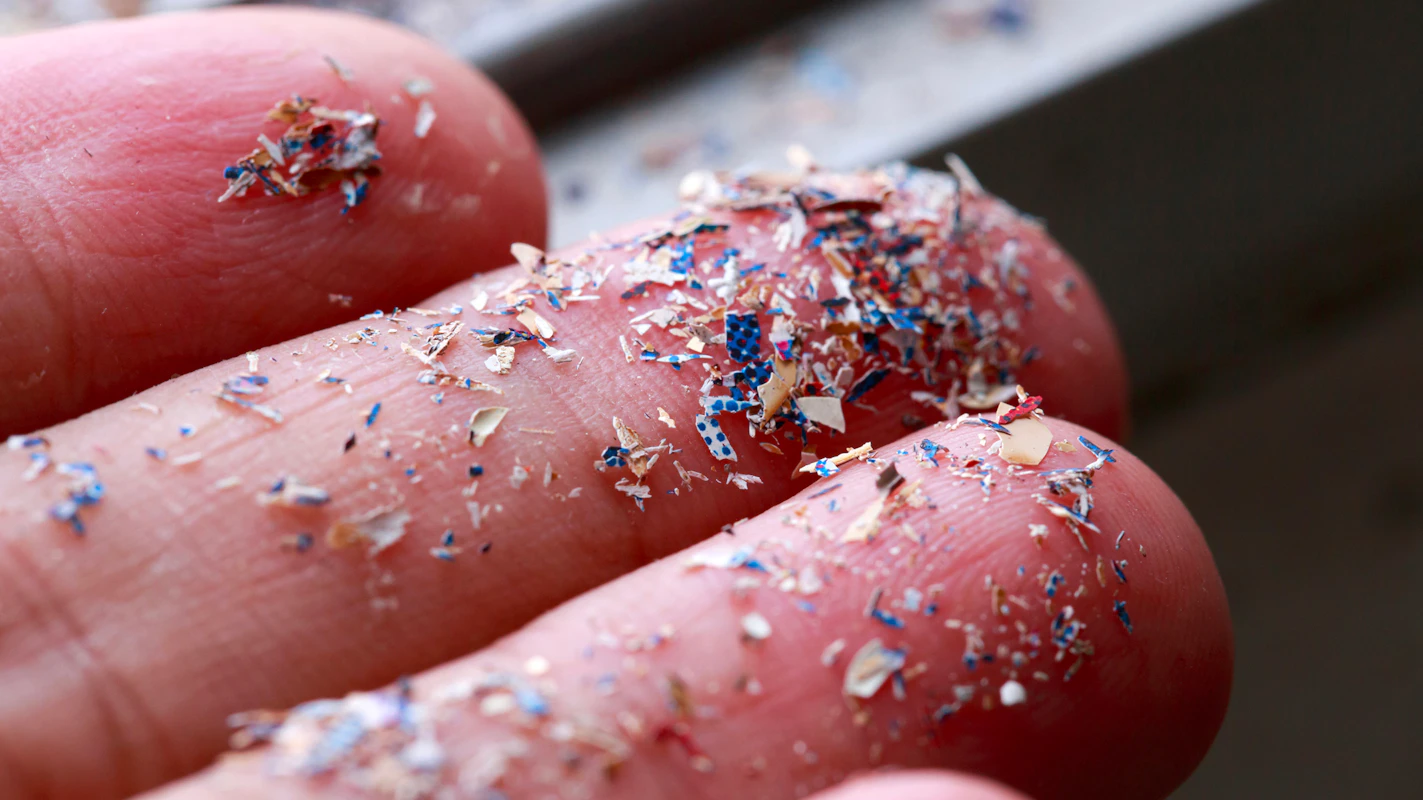
They’re showing up everywhere: in bottled water, tap water, food, air—even inside us.
That's because plastic doesn't decompose like a banana peel.
Instead, it breaks down through a process called photodegradation, where sunlight, heat, and friction gradually break it into smaller and smaller pieces.
And rather than disappearing, those pieces keep multiplying.
Over time, one plastic bottle can splinter into millions of microscopic fragments called microplastics—and eventually nanoplastics—that almost never fully disappear from the environment.
At less than 5 millimeters in size, microplastics are about the size of a sesame seed (or smaller). And nanoplastics are up to 5,000 times smaller than microplastics.
Some are so tiny, they can pass through cellular membranes and cross the blood-brain barrier, where they can infiltrate vital organs and tissue.
That's why they're not just in the environment... they're in us.
Studies have found microplastics and nanoplastics in placental tissue, breast milk, lungs, and even the human brain.
But why does that matter?
Because these tiny particles are like chemical delivery systems, carrying toxins like BPA and phthalates into the body.
And these chemicals are known to:
In fact, one recent study found that individuals with dementia had up to 10x more microplastics in their brains than those without—suggesting a possible link to Alzheimer’s and other neurodegenerative conditions.
Microplastics exposure has also been linked to:
And perhaps most concerning: researchers admit we’re only beginning to understand the full scope of harm microplastics may cause.
Meanwhile, the average person now consumes about 5 grams of plastic every week—roughly the size of a credit card—primarily through drinking water, food, and plasticware.
![[TF] clearblue cf icon 2bwordmarkup lockup small 51cebc6ee571](http://clearlyfiltered.com/cdn/shop/files/clearblue-cf-icon-2bwordmarkup-lockup-small-51cebc6ee571.png?height=42&v=1780135840)


![[TF] clearblue cf icon 2bwordmarkup lockup small 51cebc6ee571](http://clearlyfiltered.com/cdn/shop/files/clearblue-cf-icon-2bwordmarkup-lockup-small-51cebc6ee571.png?height=36&v=1780135840)


